


What Is Organic Modern Interior Design? The ALI & SHEA DESIGN Approach for Mountain Homes

Table of Contents:
QUICK ANSWER Organic modern interior design is a design approach that brings natural materials, organic forms, and a restrained, landscape-derived palette together in a space that feels refined and genuinely connected to the natural world. Not rustic. Not minimalist. It sits between those registers: the warmth and texture of natural materials held within a clean, considered structure. In mountain homes, it is not a decorative layer applied to the architecture. It is the architecture and the interior resolved as a single decision. |
Some rooms look organic and modern, and some rooms are not.
The difference is not in the product selections.
A room that is genuinely organic modern has a specific quality: the materials feel like they belong to the building rather than arrived in it, the palette reads as though it was derived from the landscape outside the windows, and the forms are considered without being geometric. Nothing in the room feels like it needs justifying.
Most rooms that attempt the aesthetic stop at furniture procurement: a curved sofa, some linen cushions, a travertine coffee table, and a terracotta wall. That is a mood board applied to a room. It looks right in photographs and feels slightly off in person.
ALI & SHEA DESIGN works in Aspen and Snowmass, where the landscape and the architecture make organic modern not a style choice but a logical response to where a home sits. This is how we think about it.
What Is Organic Modern Style? How We Define It
Organic modern is a design approach, not a period style. There is no founding decade, no set of approved furniture pieces. What defines it is a set of principles:
How materials are used,
How form is approached,
What the palette is derived from, and
What the room is edited down to.
That absence of a fixed reference is part of why it gets diluted so easily. Without a clear definition, it becomes warm tones and a few plants.
ORGANIC MODERN DESIGN CHARACTERISTICS Four principles define the style:
|
What Organic Modern Style Is Not
It is not rustic. Rustic uses natural materials decoratively, as atmosphere and texture layered on top of a space. Organic modern uses them structurally, as the primary language of the room. The difference is whether the stone wall defines the room or adds character to it.
It is not bohemian. Bohemian accumulates objects and layers patterns. Organic modern edits ruthlessly. More objects with organic provenance do not equal more organic modern. It is not Japandi either. Japandi is cooler, more linear, and less materially rich. Organic modern is warmer, heavier, and more textured.

Materials Used in Organic Modern Interior Design
If there is one thing that separates an organic modern room from one that is trying to be, it is material quality. Cheap materials in organic forms and warm tones produce a room that looks right and feels wrong. The quality of the material is not a luxury consideration. It is structural to the style.
Stone (limestone, travertine, quartzite): not a surface treatment. Stone defines the room's fundamental character. Large format, minimal joints, honest finish. In Aspen and Snowmass homes, the interior stone should feel connected to the geological landscape outside, not like a product brought in from a showroom.
Timber: exposed structural beams, reclaimed wood, wide-plank floors with natural finish. The key is that timber reads as structure, not decoration. A lacquered beam performs permanence. A reclaimed beam with visible history belongs.
Plaster: smooth or subtly textured plaster walls absorb and diffuse light rather than reflecting it. The room feels warmer and calmer as a result. Paint on drywall, however warm the tone, does not replicate this. The material quality is in the surface itself.
Natural textiles: linen, wool, bouclé in natural or barely-dyed tones. No synthetic upholstery fabrics. Performance wool bouclé exists now for vacation properties where durability matters. There is no reason to compromise the material integrity of the room.
Metal (blackened steel, aged brass) and ceramic are used sparingly. Always structurally or as handmade objects. Nothing that reads as precision-manufactured or decorative.
Upholstery is where material quality shows most and where most budgets get rationalised first. A correctly proportioned sofa in cheap synthetic fabric reads worse than a slightly imperfect sofa in quality wool. The material is not a finish. It is the piece.
Working on material selections for a mountain home? ALI & SHEA DESIGN approaches every room from the material palette out. We would like to think through yours. |

The Organic Modern Color Palette: Landscape-Led, Not Trend-Led
The organic modern palette is not chosen from a color reference. It is derived from the specific landscape the home sits in. In Aspen and Snowmass, that means the grey-white of quartzite in January light, the warm brown of pine resin in late summer, the charcoal of wet granite, the pale gold of afternoon at 8,000 feet. Warm without being yellow. Present without being loud. Restrained without being cold.
Warm neutrals as the structural base: off-white, warm greige, pale ochre, soft clay. Deep tones as anchors: forest green, charcoal, terracotta, dark walnut.
Color lives in the materials, not primarily in the paint. The stone, timber, leather, and textiles carry the color story. The walls are the backdrop.
No stark white. It fights the material warmth that defines the style. Stark white makes stone look imported and timber look painted.
Designer Tip from Ali & Shea: To get more of an organic feel in a paint without plastering or adding heavy texture to the wall, one of our favorite go-to’s is JH Wall Paint's limewash paint. Get in touch with us now. go-tos |
Dark Organic Modern Interior Design
Dark organic modern is the organic modern palette pushed into its deeper register: charcoal plaster, dark-stained timber, deep forest green upholstery, blackened steel. In mountain homes, this palette has a specific logic that it does not have in urban interiors.
These homes are designed in part to be somewhere you want to be when it is snowing outside. A room with dark plastered walls, a stone floor, and a lit fireplace does not feel heavy. It feels like exactly where you should be.
It works when the room has adequate natural light or views to carry the depth of tone, when material quality reads as richness rather than dimness, and when lighting design creates warmth at night rather than brightness. It fails when the dark palette is applied without those conditions: low ceilings, small windows, poor light.
How ALI & SHEA DESIGN Applies Organic Modern in Mountain Homes
We do not apply organic modern as a style. A style is a set of references. What we apply is a set of principles to the specific conditions of your building, your landscape, and you.
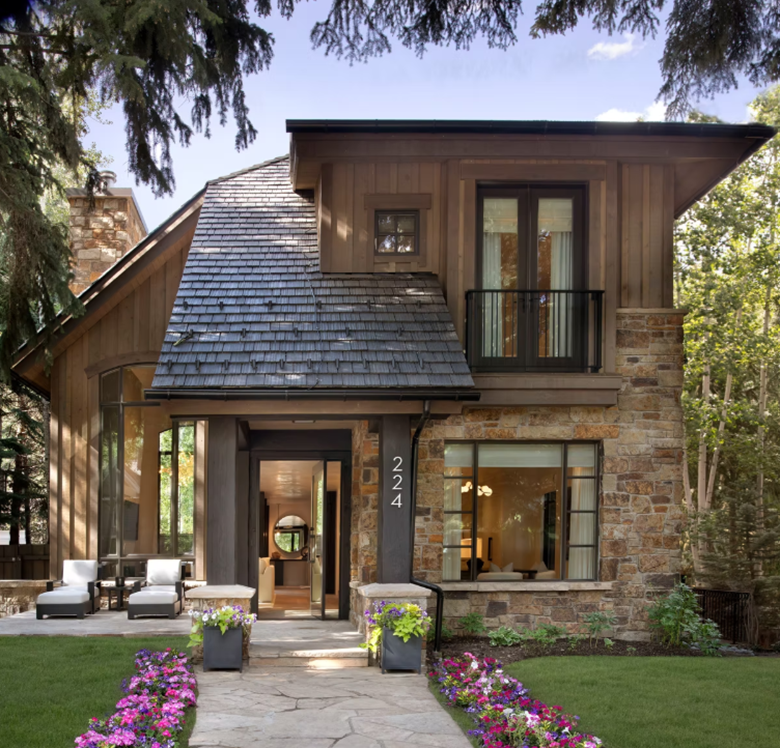
Mountain home architecture already speaks the language of organic modern: geological materials, structural timber, and large openings to the landscape. A well-designed mountain home does not need this style imposed on it. It needs an interior that responds to what the building is already doing.
When the architecture and the interior are resolved together, the result is a room that feels inevitable rather than designed. This is where most mountain home interiors fail: the architecture is honest and materially rich, and the interior has no relationship to it. The rooms look like they could belong to any mountain home anywhere.
Scale matters here in ways it does not in smaller spaces. Organic modern furniture and materials designed for a 2,000 square foot home need reinterpretation in a 6,000 square foot great room. The principles hold. The proportions shift. And the view is not a backdrop. In mountain homes with floor-to-ceiling glazing, the landscape outside is an active element of the interior composition. The palette of the room and the palette of the landscape should be in dialogue, not in competition.
DESIGNER NOTE The most resolved organic modern rooms we design in Aspen and Snowmass share one quality: you could not move the furniture to a different house and have it make sense. The pieces belong to the room, the room belongs to the building, and the building belongs to the landscape. That coherence is what we are always working toward. |
What Dilutes Organic Modern: The Mistakes We See Most Often
Most of these share the same root cause: the style is applied as an aesthetic rather than built as a structural approach.
What Goes Wrong | Why It Fails and the Fix |
Natural materials as accessories | A stone feature wall, a plant, a linen throw. If the natural materials are accessories rather than the structural language of the room, it is not organic modern. Stone should define the room. Timber should be structural. |
Warm palette without material quality | Terracotta paint and linen cushions do not make an organic modern room. The plaster surface, the stone, and the timber finish are non-negotiable. Organic modern with cheap materials reads as an approximation, not an execution. |
Dark palette without the right conditions | Dark organic modern requires natural light or views to carry the depth of tone. Applied in a room without those conditions, a dark palette creates heaviness rather than shelter. |
Over-styling | More ceramic objects and organic textures do not automatically make a space feel resolved. The room should feel like everything within it belongs uniquely to that space and nowhere else. |

Working With ALI & SHEA DESIGN
A room that genuinely embodies organic modern has a quality that is easy to experience and harder to describe. It feels settled. The materials are not performing. The palette is not attempting. The room feels like it grew from the landscape it sits in rather than being assembled from a brief.
If you want the safest version of organic modern, some firms will give you warm neutrals and curved furniture and call it done. We design homes that feel inseparable from their landscape and unmistakably yours.
If you want a home that feels like it grew from the landscape it sits in, let's talk. ALI & SHEA DESIGN offers full-service interior design and architecture for mountain homes in Aspen and Snowmass. We ask different questions before we draw a line. The goal is not to win approvals. It is to design a life. Contact ALI & SHEA DESIGN |
Frequently Asked Questions
Does organic modern design work well for second homes and vacation properties?
Yes. Organic modern interiors often work particularly well in vacation homes because they prioritize calm, durability, and connection to the surrounding environment. In Aspen and Snowmass, many homeowners also prefer materials that age naturally and require less visual maintenance over time, especially in homes that may sit vacant seasonally.
How do you child-proof an organic modern home without compromising the design?
The key is choosing durable natural materials from the beginning rather than relying on delicate finishes. Performance wool, textured stone, rounded furniture profiles, and integrated storage allow a home to remain visually restrained while still functioning comfortably for family life.
What types of countertops work best in organic modern kitchens?
Quartzite, honed marble, soapstone, and textured natural stone tend to work best because they introduce depth and variation without looking overly polished. The finish matters as much as the material itself. Organic modern kitchens typically avoid surfaces that feel excessively glossy or manufactured.
Can organic modern interiors include antiques or collected pieces?
Absolutely. In fact, collected objects often make an organic modern home feel more grounded and personal. The difference is in restraint and placement. A few meaningful vintage or handmade pieces usually have more impact than filling a room with decorative accessories.
How do you prevent an organic modern home from feeling too beige?
Contrast is essential. The strongest organic modern interiors balance warm neutrals with darker grounding elements such as charcoal plaster, aged wood, blackened steel, or deep-toned textiles. Texture, shadow, and material variation also create visual depth without relying on bright color.
Are open floor plans necessary for organic modern design?
No. Organic modern design depends more on material continuity, proportion, and natural light than on whether a home is a fully open concept. Well-defined rooms can feel just as connected and calming when the architectural language remains consistent throughout the home.
What window treatments work best in organic modern interiors?
Natural woven shades, linen drapery, and quiet architectural treatments tend to work best because they soften light without competing with the surrounding landscape. In mountain homes, window treatments are often designed to frame views rather than dominate them.
Is organic modern a good fit for homes with large mountain views?
Yes, because the design approach tends to support rather than compete with the landscape. Restrained palettes, natural materials, and quieter forms allow the outdoor environment to remain visually prominent instead of being overshadowed by the interiors.
How do organic modern homes age over time?
Well-designed organic modern homes typically age beautifully because the materials develop character rather than deterioration. Natural stone softens, timber deepens in tone, and metals develop patina. The home evolves naturally instead of feeling dated after a few years.
What makes organic modern interiors feel more personal than minimalist spaces?
Minimalist interiors can sometimes feel detached because they prioritize reduction above all else. Organic modern interiors tend to feel more lived-in because they rely on texture, material warmth, and subtle variation to create emotional depth without visual excess.
Are plaster walls worth it in mountain homes?
In many cases, yes. Plaster changes the way light moves through a room and adds surface depth that standard drywall cannot replicate. In Aspen and Snowmass homes, especially, plaster often helps interiors feel quieter, warmer, and more architecturally grounded.
What furniture shapes work best in organic modern interiors?
Softer silhouettes usually work best: curved edges, rounded profiles, low proportions, and forms that feel sculpted rather than rigidly geometric. The goal is not trend-driven curves, but furniture that feels visually relaxed and connected to the material language of the home.


I enjoy lore references more when places and events can be connected instead of opened as unrelated pages. The Interactive Middle-earth Map gives that exploration a useful visual starting point.
The article makes a fair point about lowering the barrier to trying something new. Pokémon Team Builder gave me a quick way to look at team balance in one place, which was useful when I only wanted to test an idea.
While taking a break at https://netellercasinoplay.com, the part about organic modern being "a mood board applied to a room" when it's just furniture procurement hit home. I've sat in plenty of spaces that photographed beautifully but felt off, and you articulated exactly why. It makes me wonder if more designers should start with the structure rather than the showroom.
Clear examples make technical concepts much easier to remember. The address 10.10 0.1 can be used to explain why spaces should not appear inside a normal IPv4 address and how proper formatting improves the accuracy of network troubleshooting.
This article gave me a better way to think about focused web experiences. TFTFans is one example I encountered when I needed to compare the current Teamfight Tactics meta comps, and it kept the process pleasantly small.