


Designing A Living Room With A Fireplace: What Actually Works in Mountain Homes

Table of Contents:
QUICK ANSWER Designing a living room around a fireplace means making three decisions in the right order:
Get that sequence right, and the fireplace does what it's supposed to: anchor the entire space. |
Most living rooms have a fireplace. Very few are actually designed around one.
There's a difference. A fireplace that happens to exist in a room is a box in a wall. A fireplace that a room is designed around becomes the reason the space works, the reason the seating pulls you in, the reason guests gravitate to that corner the moment they walk through the door.
In mountain homes especially, the fireplace determines how the room is arranged, how the furniture sits, and where people naturally gather.
This guide covers all three decisions, whether you're choosing a fireplace for a new build, renovating around an existing one, or rethinking a layout that's never quite felt right.
Which Fireplace Type Is Right for Your Living Room?
This is the first decision, and it affects everything downstream.
The fireplace type you choose determines your surround options, your layout constraints, and the maintenance reality you'll live with for the life of the home.
Here's how each option stacks up, with an honest take on what works in mountain homes.
The five main fireplace types for residential living rooms:
Type | Best For | Mountain Home Fit | The Honest Consideration |
Wood-burning | Primary residences: homes where the ritual matters | Excellent when architecture supports it |
|
Gas | Vacation homes; high-use primary residences | Ideal, reliable, clean, remote ignition |
|
Electric | Spaces where venting is impossible: mountain condos | Limited suits contemporary condo settings |
|
Double-sided | Open-plan layouts; living/dining dividers; inside/outside | Outstanding makes an architectural statement |
|
Indoor/outdoor | Homes with covered terraces or loggias | Purpose-built for this environment |
|
Wood-Burning: Worth It Under the Right Conditions
Nothing replicates a wood fire, the sound, the smell, the quality of the light.
Worth the planning in Aspen and Snowmass primary residences with the right architecture
At an altitude above 8,000 feet, combustion behaves differently. Consult a professional on flue and firebox specifications before committing.
Local regulations on wood-burning vary by county; check before specifying
Design the flue from the start, not as an afterthought
Gas: The Right Call for Mountain Vacation Homes
Clean, controllable, and ready the moment you arrive, no prep, no delay
Contemporary gas inserts have closed the aesthetic gap considerably
Remote ignition is a design decision, not a luxury add-on
For any Aspen or Snowmass vacation property, a gas fireplace is a good choice because it is reliable, easy to ignite, and low-maintenance.
Double-Sided and See-Through: The Architectural Move
Between the living room and dining room, or the interior and covered terrace, a double-sided fireplace is one of the most powerful statements available in open-plan mountain homes.
The rule: both sides must be designed with the same intention
A spectacular living room side with an ignored dining room side is a missed opportunity and an aesthetic problem
Resolve both zones at the planning stage, before either room is furnished
DESIGNER TIP In Aspen and Snowmass properties, gas fireplaces dominate for one practical reason: they work the moment you walk through the door. A vacation home that requires prep before you can light a fire has already failed. Save wood-burning for primary residences where the ritual is the point. |
How to Style a Fireplace Surround in a Living Room

The surround is the fireplace's frame. Like any frame, it either enhances what's inside it or competes with it. The fireplace surround material, mantel composition, what sits above the fire, and how it all relates to the room need to be resolved together. Not separately.
SURROUND STYLING: THE PRINCIPLE The fireplace's surroundings should command the wall it's on without competing with everything else in the room. Three rules:
|
Which Surround Materials Work in Mountain Homes
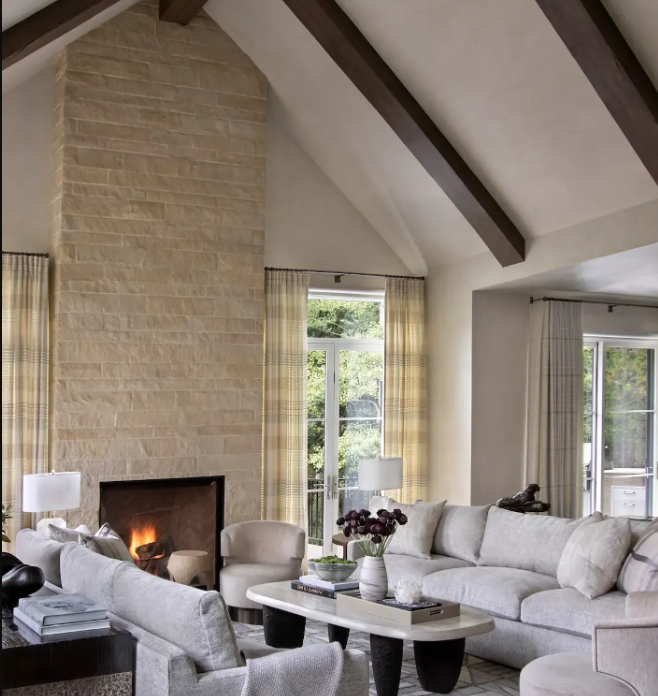
The mountain environment sets a material palette of stone, plaster, and wood, and the surroundings should come from that same palette.
A surround that feels imported rather than belonging to the architecture is one of the most common errors in Aspen and Snowmass home design.
Limestone and quartzite are clean, pale, architecturally serious; limestone reads as refined without being precious; quartzite adds movement and warmth; both suit contemporary and transitional mountain interiors.
Plaster is the most versatile option; a smooth plaster surround disappears into the wall in the best way, making the fireplace a composition rather than an insertion. It works across contemporary, rustic, and transitional styles.
Stacked or ledger stone, the traditional mountain choice; executed well (consistent coursing, appropriate scale), it's timeless; executed poorly, it reads like a 2005 ski chalet; the difference is entirely in the stone selection and the detailing.
Blackened steel, the contemporary statement; a steel surround in a room of warm wood and natural stone creates intentional contrast that reads as sophisticated, not accidental
Wood paneling works when the fireplace is one element in a larger wall composition (bookshelves, built-ins, cabinetry), not the sole focal point.
How to Style the Mantel Shelf Without Over-Decorating It

The mantel shelf is one of the most over-decorated surfaces in interior design. The instinct to fill it is understandable. The result is almost always a fireplace that reads as cluttered rather than considered.
Fewer objects, better objects, more space between them, that's the principle.
Odd numbers and varied heights create tension. Uniform spacing makes the arrangement look staged rather than considered.
Leaning a large-scale artwork rather than hanging it feels more deliberate and is much easier to change.
Leave at least a third of the mantel surface clear; the fireplace needs room to breathe.
If the fire is lit, nothing on the mantel should pull more attention than the flame.
What Goes Above the Fireplace, Including the TV Question
This comes up on almost every project. The answer is more nuanced than a simple yes or no. A television above a fireplace can work under the right conditions, but it needs to be resolved intentionally rather than treated as the default solution.
Viewing Height Matters
The primary consideration is viewing height. If the television sits too high above the firebox, the viewing angle becomes uncomfortable over time, particularly in living rooms designed for long evenings rather than occasional use.
In most cases, the center of the screen should sit within a comfortable seated sightline, though the exact height depends on room scale, seating distance, and fireplace proportions.
Heat Protection Should Be Considered Early
A substantial mantel or separation detail between the firebox and television helps reduce heat exposure and creates a more considered architectural transition between the two elements.
The relationship between the firebox, mantel, and screen should be resolved as part of the architectural composition rather than added afterward.
The Room Still Needs a Clear Focal Point
A room organized equally around a fireplace and a television often struggles to create a clear visual hierarchy. The strongest rooms resolve this intentionally from the beginning rather than allowing both elements to compete for attention.
When a TV Above the Fireplace Works Best
A television above a fireplace tends to work best when:
The fireplace is a low-profile gas insert rather than a large traditional firebox
The surround material is restrained: plaster, limestone, simple millwork, or smooth stone
The television is integrated into a purpose-designed media wall rather than retrofitted afterward
The room proportions support the mounting height naturally
A Frame TV or similar design allows the screen to read more like artwork when not in use
Alternatives to a TV Above the Fireplace
In rooms where the television is relocated elsewhere, the fireplace wall often becomes stronger architecturally.
Large-scale artwork, mirrors, or sculptural objects above the fireplace can create a calmer focal point that allows the materiality of the surround and the atmosphere of the fire to remain the visual emphasis.
The Right Solution Depends on the Room
There is no universal rule. The right decision depends on the proportions of the room, the scale of the fireplace wall, the seating layout, and how the space is actually used day-to-day.
DESIGNER TIP ALI & SHEA A busy room needs a calm fireplace. A spare room can carry a bold surround. Before choosing your fireplace surround material, look at what the rest of the space is already doing. If you have dramatic views, exposed beams, and patterned upholstery, a simple plaster surround is the right call. The fireplace doesn't need to compete; it needs to anchor. |
Living Room with Fireplace Paint Ideas: Color Around a Focal Point
Paint decisions in a fireplace living room are different from those in a room without one.
The fireplace wall carries more visual weight, and the color you choose needs to either support that weight or consciously contrast with it.
Neither is wrong. But the decision needs to be made deliberately.
THE CORE PAINT PRINCIPLE
|
The Fireplace Wall: Accent Color or Match the Room?
Paint the fireplace wall an accent Color when:
The surround is simple plaster, smooth stone, or a painted mantel
The room palette is otherwise neutral, and the accent will support the fireplace rather than fight it
Keep the fireplace wall the same Color as the room when:
The surround is already doing a lot, visually stacked stone, heavily grained wood, dramatic materials
A contrasting wall Color would compete with the surroundings rather than frame it
You want the material to speak for itself. The same color approach is more forgiving and often more sophisticated.
Paint Colors That Work in Mountain Home Living Rooms
Warm whites and off-whites are the most versatile choice; works in natural and artificial light; sit naturally alongside limestone, quartzite, and reclaimed wood
Soft greige and warm taupe grounds the room without competing with natural materials; the safe-but-right choice in most mountain home living rooms
Deep forest green works beautifully against a pale stone surround in a room with adequate natural light; it makes the fireplace feel embedded in the landscape
Charcoal and deep navy high-impact choices that suit contemporary mountain interiors with minimal decoration and a simple surround
Avoid:
Cool-toned whites alongside warm stone or wood, the undertone conflict makes the room feel colder and less resolved than it should
Stark grey with natural materials reads as corporate rather than considered in a mountain home context
Vaulted Ceilings: A Specific Consideration
In mountain homes with vaulted ceilings, deep wall Color can make the room feel compressed the ceiling height starts to work against you.
Keep walls at a mid-tone in vaulted rooms; let the architectural drama of the ceiling do the heavy lifting.
The fireplace provides enough visual weight at the lower register, so it doesn't need heavy Color pushing down from above.
DESIGNER TIP ALI & SHEA Test your paint choice in the actual light of the room, morning light, afternoon, and artificial evening. Mountain homes at altitude get intense light from unexpected angles. A warm white that looks perfect on a sample card can read yellow or pink under high-altitude afternoon sun. Always live with a large test patch for at least a week. |
How to Arrange Furniture in a Living Room with a Fireplace

Furniture layout is where interior design for a living room with a fireplace either succeeds or fails. You can have a beautiful surround and a perfectly resolved Color palette and still end up with a room that doesn't work because the furniture doesn't face the fire.
FURNITURE LAYOUT: THE RIGHT SEQUENCE Arrange furniture in the fireplace living room in this order:
|
The Fireplace-First Principle
The most common layout mistake: organizing the room around the television and hoping the fireplace still reads as a focal point, it won't
A sofa facing a screen on the opposite wall, with the fireplace somewhere to the side, turns the fireplace into a background detail.
All the investment in surround design and material selection is largely wasted if nobody is sitting facing it.
Orient the primary sofa or sectional so the fireplace is what you're looking at when you sit down. Start here, then solve for everything else.
Defining the Seating Zone
In generous mountain home living rooms, the instinct is to spread furniture to fill the space - resist it.
Create a conversation area that's sized for actual use: sectional or sofa with flanking chairs, coffee table, area rug that grounds the composition.
The 10-foot rule: primary seating within roughly 10 feet of the fireplace face, beyond that, the warmth and intimacy of the fire diminish.
Furniture pushed to the walls creates a waiting room, not a living room
The space behind the seating zone can do other things, such as a reading chair, a games table, or additional seating, but the fire anchors the primary zone
Sectional vs. Sofa and Chairs in Great Rooms
Large sectional:
Anchors a substantial fireplace wall effectively in symmetrical great rooms
Creates a defined, enveloping seating area that suits a high-traffic vacation home
Works best when the fireplace is centered, and the room is relatively symmetrical
Sofa plus chairs:
Reads as more collected, allowing variation in seating type and scale
Suites rooms where the fireplace is one element in a richer composition of furniture and objects
More flexible when the fireplace is offset, or the room is irregular
Neither is universally right; the choice follows from the fireplace scale, room proportions, and how the space is used
Double-Sided Fireplace Layouts
Design both sides together, the living room side and the dining room side (or interior and exterior) simultaneously
Both sides must be designed with the same intention, scale of seating, distance from the glass, and what's visible through the fireplace from each position.
A spectacular living room side with an ignored dining side is an aesthetic problem and a missed opportunity.
Mountain Home Scale: Size Up
Standard residential furniture looks lost in great rooms with vaulted ceilings and generous square footage.
The fireplace wall needs to be matched in scale. A firebox that reads well in a standard room can disappear at mountain home proportions.
Use the fireplace wall to anchor the largest-scale pieces in the room
A fireplace that reads small in a grand room loses all its power, scale the firebox opening and surround to the architecture, not a catalogue standard
A layout that’s never quite worked? Most rooms fail at layout, not decoration. ALI & SHEA designs fireplace-centred living rooms across Aspen and Snowmass, starting with the floor plan, not the finish selections. Get in touch → aliandshea.com |
Fireplace Design Mistakes That Undermine the Whole Room
These are the errors that consistently appear across fireplace living rooms. Some are expensive to fix after the fact. Most are avoidable if the decisions are made in the right order.
Mistake | Why It Fails And the Fix |
Fireplace too small for the wall | A firebox that doesn't command its wall disappears, especially in mountain homes with 18–22ft ceilings. Scale the firebox and surround to the architecture, not a residential standard. |
TV mounted too high above the fireplace | A television placed too high above the firebox creates an uncomfortable viewing angle and can make the fireplace wall feel visually top-heavy. The solution is to resolve the television height, mantel depth, seating distance, and fireplace proportions together rather than treating the screen as an afterthought. In some rooms, relocating the television to an adjacent wall or integrating it into a custom media composition creates a calmer result. |
Over-decorated mantel | Too many objects at similar heights compete with the fire. Edit hard. The fire is the focal point, the mantel supports it, not the other way around. |
Wrong surround material for the room | A Victorian ornate mantel in a contemporary mountain home, or a sleek steel box in a warm rustic lodge: mismatches read as unconsidered. The surroundings should belong to the architecture. |
Furniture facing away from the fire | If the primary seating doesn't face the fire, the investment in the fireplace is largely wasted. Orient furniture first, resolve TV placement second. |
Ignoring the hearth extension | The hearth is part of the surround composition. A beautiful stone surround with a mismatched or undersized hearth reads as unfinished. Design them together. |
Cool white paint with warm stone | Cool-toned whites fight warm stone and wood surrounds. The undertone conflict makes the room feel colder and less resolved. Use warm neutrals. |
Permanent themed surrounds in ski homes | Heavily rustic or overly lodge-aesthetic surrounds can date quickly and limit the room's design flexibility. Keep the surroundings timeless; inject character through textiles and accessories. |
Designing a Fireplace-Centred Living Room with ALI & SHEA
A fireplace is one of the few design decisions that affects how a room feels every single day. Most rooms that don't work around a fireplace have the same problems: the furniture faces the wrong thing, the surround is underscaled, or the material doesn't belong to the architecture. These aren't decorating problems; they're design problems. And they're avoidable.
ALI & SHEA is a full-service interior design and architecture firm led by Alison Agley and Carrera Shea, based in Aspen, Colorado
We design elevated, functional mountain homes across Aspen, Snowmass, and the surrounding mountain communities.
Our approach covers fireplace specifications, surround design, material selection, furniture layout, and full-room integration, not just finish selections.
Ready to design your living room around a fireplace? If you want a space that feels like you, not a showroom, not a safe Aspen standard, we’d like to hear about your project. Contact ALI & SHEA Design → aliandshea.com |
Frequently Asked Questions
Should a fireplace always be centered in a living room
Not necessarily. A fireplace should align with the architecture of the room and the natural layout of the seating area. In some rooms, an off-center fireplace allows better furniture placement and circulation.
Can a TV go above a fireplace?
It can, but the decision should consider viewing height, room proportions, and visual balance. In many living rooms, placing the television on a nearby wall produces a calmer design.
What colors work best around a fireplace
Neutral tones and natural colors tend to work best. These palettes allow the material of the fireplace to remain the visual focus while keeping the room balanced.
How far should seating be from a fireplace?
The ideal distance depends on the scale of the room and the type of fireplace. In most living rooms, seating should feel close enough to enjoy the fire while still allowing comfortable movement around the room.


What I love most about https://leafguard.pissedconsumer.com/review.html I had the pleasure of utilizing LeafGuard Gutters for my home, and I must say, the experience was exceptional. The installation process was efficient and seamless, with the team demonstrating a high level of professionalism and expertise. The gutters themselves have proven to be remarkably effective, significantly reducing debris accumulation and ensuring optimal water flow. Additionally, the craftsmanship in the carpentry work was outstanding, enhancing the overall aesthetic of my home. I highly recommend LeafGuard Gutters for anyone seeking reliable and high-quality gutter solutions.
The fireplace-as-focal-point advice is spot-on for mountain homes, but I’d add that positioning seating to face both the fire and the view makes all the difference. I’ve been using a layout tool that helps visualize that balance—check out https://muse-video.pro
The fireplace-as-focal-point advice is spot-on—in mountain homes, it’s all about balancing that massive stone hearth with lighter, low-profile furniture so the room doesn’t feel like a cave. I’ve been using a similar layout guide for our cabin’s great room, and it’s made a huge difference in how the space flows. Check out https://image-to-video.org
The fireplace-as-focal-point advice is spot on—we positioned ours opposite the main seating and it completely changed the flow of our mountain home. I've been using a layout tool that made this exact kind of planning way easier, check out https://aiface-swap.com
The fireplace-as-focal-point tip is spot on—in mountain homes, it really does anchor the whole layout, especially with those tall ceilings. I've been using a similar approach for arranging seating around ours, and the difference is night and day. Check out the layout guide I found at https://omni-gemini.net